


IN 1900, as international troops swamped Beijing on the heels of an anti-foreign movement known internationally as the “Boxers,” an on-the-run Chinese official snuck back into the city disguised as a Buddhist monk. Two years earlier, Empress Dowager Cixi had crushed a reform movement; the monk in disguise – Wang Zhao – was part of it. Six of his fellow reformers had been beheaded without trial.
Wang was a wanted man. But he returned with a secret – a Chinese syllabary (think an expanded alphabet in syllables) sewn into his robes. He told anyone who asked that he'd brought his secret from the barbarian outpost of Taiwan, which was so distant from the Chinese cultural heartland of Beijing it was akin to telling someone in London that he’d acquired the alphabet of the future – from Timbuktu.
Writes Jing Tsu of Taiwan:
The island was distant enough from the locals’ knowledge to be a credible cover. For centuries pirates had gathered on the island while trolling the South China Sea. Hiding in the crevices of its jagged landscape, they shared the mountainous no-man’s-land with indigenous headhunting tribes and political castaways. Then Japan seized it as its first colony in 1895, after an easy victory over China in the First Sino-Japanese War. It was a haven for uninvited guests, safe beyond the reaches of Chinese law.
If that weren’t odd enough, several years later, Wang did something stranger still: he turned himself in to the Beijing military authorities — not for clemency – but, as Tsu tells it, to claim his syllabary as his own before anyone else could. The outcome was that he did two months “inside” before being swept into a Qing court general amnesty (linked to Empress Dowager Cixi’s 70th birthday celebrations) and being released, his original rank restored, living another 30 years.
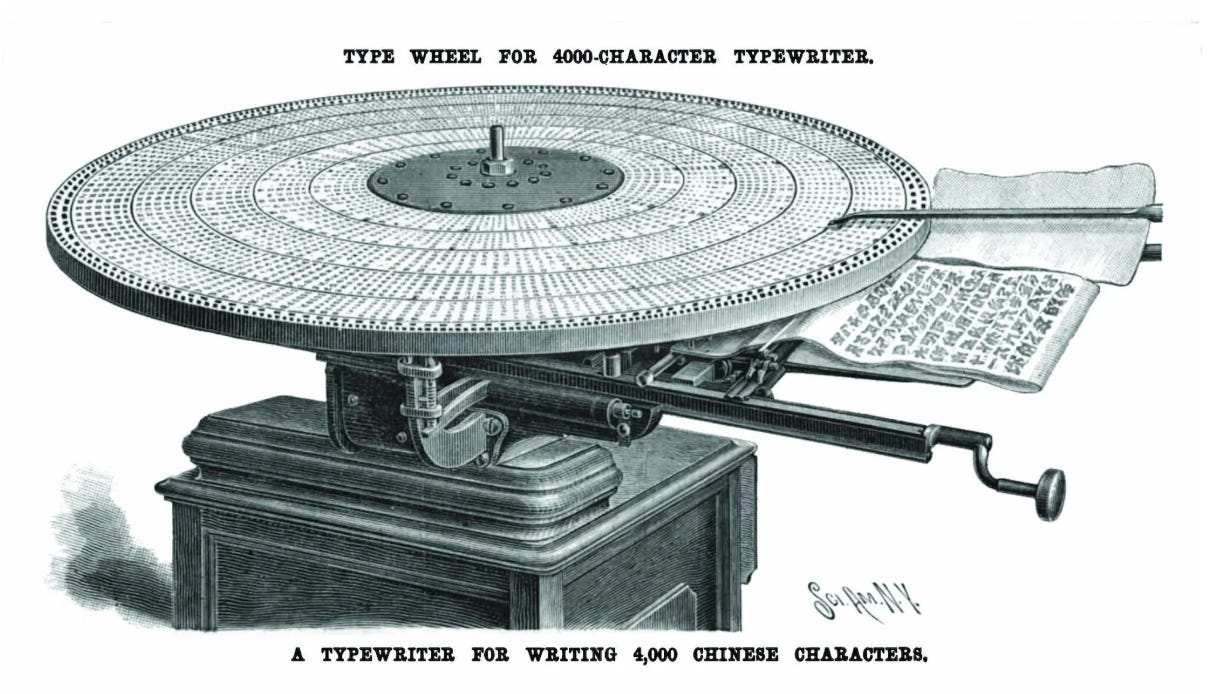
Such are the peculiar minds that populate Jing Tsu’s Kingdom of Characters – minds who became convinced that a technical problem with the Chinese script accounted for the abyss between China and the modern world. These were the Chinese intelligentsia who’d spent time abroad and had turned their lives upside down to bridge the gap between languages expressed in alphabetic scripts and the jaw-dropping 47,000-character dictionary commissioned by the Kangxi Emperor in 1710 and completed in 1716, organizing characters under the 214 radical system (the brush-stroke building blocks, if you like, of characters) that’s still the backbone of old-school Chinese dictionary lookup today.
For two centuries afterward it functioned as the closest thing that China had to a gold-standard for how a character should be written, sounded, and understood. It’s also the reason that the answer to “how many characters are there in Chinese?” still tends to hover around the Kangxi dictionary number of 47,000, despite many being rare, obsolete, or variant forms that are known or used by next to no one.
In other words, China was in a particularly unique place when the red-haired barbarians began arriving across the seas on their gun-ships from the distant West. Surely the celestial empire, the greatest cultural power in the world, complete with a meticulously documented language would prevail against innovative gimmickry and would like all former invading forces eventually fall in awe of it as a cultural force unlike any other.
Except, this time was different. Some Chinese intellectuals started to ask whether the innate mystery of the Chinese written language – so difficult to master that doing so bestowed something that mastery of no other written language did – actually represent a barrier to a modern world that was knocking on its door.
For centuries, China had been shrouded in a mystery and the core of that mystery was, as author Jing Tsu put it:
How an entire civilization outside of Christendom [had] evolved to have a writing system as complex and massive as the Chinese script … [masking] a deep suspicion: How can a people who read and write in characters ever think the way we do? Even in the late twentieth century, views like this were touted by Western experts in different fields. Alphabetic thinking, social theorists would say, explains the advent of the scientific revolution in the West. A modern theorist of networks and the digital age sees the alphabet as a conceptual technology that forms the bedrock of Western science and technology. A scholar of ancient Greece saw the signs much earlier at the fount of Western civilization, where “the alphabetic mind” was responsible for all the West’s accomplishments. Joseph Needham, a renowned British historian of Chinese science, spent his life’s work defending scientific inventions in ancient China against claims like these, but he also recognized that the Chinese language remained the greatest barrier for Westerners to understanding the minds of the Chinese. It is China’s first and last Great Wall.
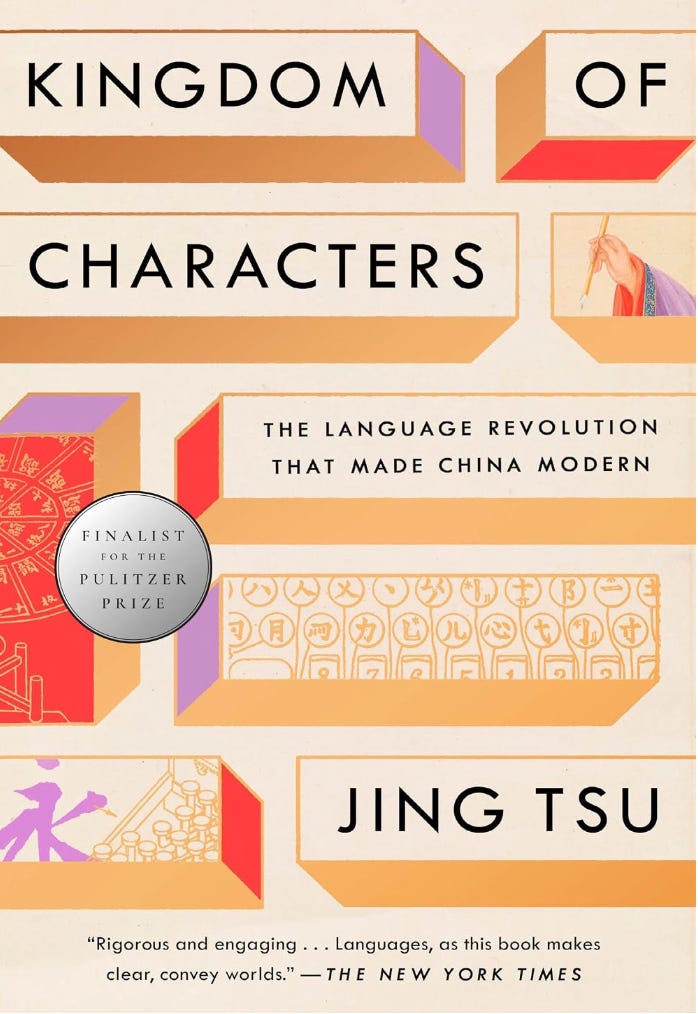
Kingdom of Characters: The Language Revolution that Made China Modern
Jing Tsu
Houghton Mifflin Harcourt (March 13, 2018)
288 pages
ISBN-13: 978-0735214743
Jing Tsu’s Kingdom holds together as an intellectual history. But it’s the portrait gallery that makes it a read that isn’t forgotten in a hurry — a roll-call of eccentric thinkers, each certain that he – seriously, it’s always a “he,” it’s worth repeating – alone has found the missing key to China’s place in the modern world. The pleasure is in the specificity of their obsessions.
It fades with the arrival of linguistic committees — but fortunately not before reams of rewarding reading. But before they arrive, the aforementioned Wang Zhao gets the fullest treatment. His syllabary grew out of a genuine diagnosis, one shared by many reformers – the fact that China’s hundreds of mutually unintelligible spoken dialects shared a single written script.
Officials posted from the capital to the provinces described the experience as being “dispatched abroad,” and the “Mandarin” they all fell back on for official business wasn’t even the Mandarin they’d grown up speaking.
It was, by any measure, a country linguistically at odds with itself. Wang’s answer was to standardize the sound of the language first, on the theory that a common spoken tongue, notated phonetically, could unify the country in a way the written script alone never had — and that literacy built on that foundation could be extended, for the first time, to the peasantry rather than staying the property of a small scholar-official class. It’s a genuinely serious piece of political thinking. But once the syllabary caught on, Wang grew obsessed less with its success than with controlling it.
He became furious at “hack copycats,” determined that no one profit from his invention but him, even while sitting in a prison cell. Barbs were exchanged with the likes of Zhou Houkun, a Chinese engineering student trained at MIT who built a character-grid machine around the traditional 214 Kangxi radicals used in Chinese dictionaries for centuries. Qi Xuan, working independently in New York, built a rival machine using interchangeable character components instead of whole characters.
Personal insults were exchanged in the letters pages of a Chinese students’ newsletter, arguing over whether the “mouth” radical can legitimately change size and position depending on what character it belongs to.
Qi accuses Zhou of failing to grasp his own invention; Zhou’s objections turn out to be as much aesthetic and moral as technical — to him, dismantling a character and reassembling it from parts felt like a violation of something that was supposed to stay whole – unviolated.
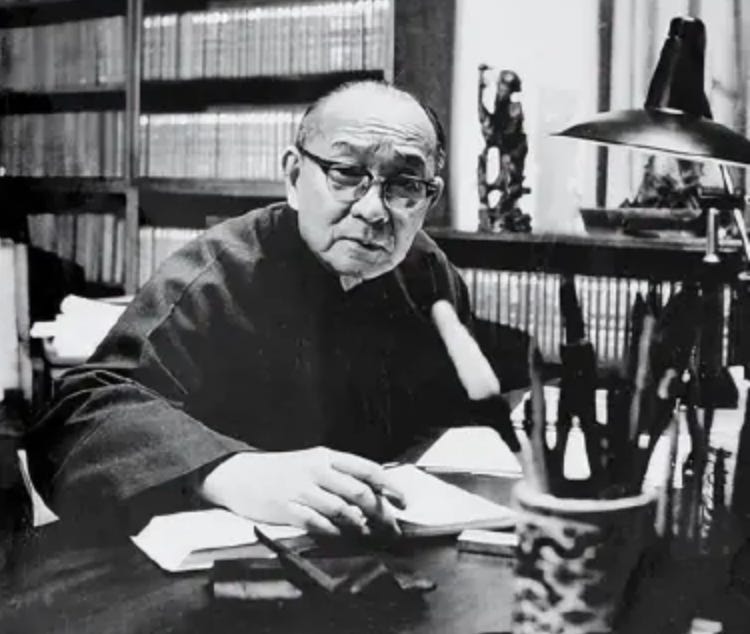
Meanwhile, Lin Yutang, who was twice nominated for the Nobel Prize for literature, deserves his own special place in the intersection of Chinese language and the languages of the West. Lin was, by his own account, ashamed of how little of the Chinese literary tradition he possessed.
He was a Shanghai-educated cosmopolitan who could recite the fall of Jericho from memory and draw a blank on legends even Shanghai laundrymen knew, if author Jing Tsu is to be believed.
Out of that specific embarrassment came decades of Chinese work at it’s most demanding – knuckling down onto stroke-based indexing systems for organizing Chinese characters. That eventually led to the Mingkwai typewriter, which – when the time came, and as legend has it – he carried home through Manhattan wrapped in waxed paper like a smuggled infant, by his own description “as excited as a schoolboy.”
It speaks to every character in this book: nobody was a dispassionate technician solving neutral problems. Everyone was working through their own connection between China and the modern world – and at any cost.
Zhi Bingyi — a Leipzig-trained physicist turned instrument engineer who returned to China and wound up in a cell – is the starkest version of this pattern. Caught up in the Cultural Revolution, Zhi works out a four-letter character-encoding system — breaking characters into components, assigning them alphabet codes — while sitting in solitary confinement, with no computer anywhere near him to test any of it on. The idea sitting unverified in his head for years is the purest distillation of what Kingdom of Characters is actually cataloguing: total obsession with a script problem, disconnected from any institutional reward.
Everything before this point has been building toward sketched variations on the same portrait — the fugitive monk, the costumed engineer, the abashed literary striver, the prisoner solving equations he can’t run.
The chapters that follow — simplification, pinyin, computerization, Unicode — are where the book’s early propulsion gives way to something more monolithic. There’s no point pretending it makes for a more fun read, but that’s not really Kingdom’s fault – the book is doing its duty. Chinese language reform slipped out of the hands of eccentrics and became the domain of committees, ministries and eventually even international standards bodies.
To paraphrase from the "When 'Peking' Became 'Beijing'" chapter of Kingdom, The 1955 Committee on Script Reform is described as twelve men who’d spent their youths trying to overthrow the classical language and had, by then, survived enough failed revolutions and near-conquests to know how easily dreams get upended — a nice grace note before the material turns procedural: draft schemes, hundreds of thousands of public comment letters, a typesetter’s testimonial about how much easier the simplified forms are to pick out of a type case.
Zhi Bingyi gets one last vivid scene worth flagging on its own terms — his “On-Sight” encoding system, worked out in solitary confinement, breaking the character for “road” into four components to yield the code KZPK, or compressing the seven characters of “People’s Republic of China” into ZHRMGHG.
It’s the last moment in the book where a single obsessive mind, working entirely alone and without a machine to test any of it on, produces something that later becomes infrastructure — after that, invention becomes increasingly indistinguishable from administration.
The telegraphy chapters are where the book’s argument sharpens into something closer to a thesis about infrastructure and power. Morse code was built for the Western alphabet and never designed with ideographic scripts in mind; the workaround, engineered by the French naval officer Septime Auguste Viguier for the Danish Great Northern Telegraph Company in 1872, mapped roughly 6,899 Chinese characters onto four-digit numbers. It worked, and it became the template for every Chinese telegraphic codebook for the next century — but numbers, under Morse’s original pricing scheme, cost more to send than letters. Viguier had solved the technical problem while leaving the Chinese language, quite literally, priced as a second-class citizen of the medium. Tsu is good on how this wasn’t malice so much as a Frenchman solving the problem in the only frame he had.
What follows is a minor, satisfying relay race: the diplomat Zhang Deyi building his own competing codebook after chafing at having to route urgent Chinese messages through “foreign letters”; the reformer Wang Jingchun eventually looping back to Bopomofo itself, mapping its phonetic symbols onto Roman letters to produce a four-letter code — sound, tone, and radical — that let characters travel by wire without resorting to numbers at all, a scheme formally adopted by the Ministry of Communications in 1929. It’s a nice structural rhyme with Wang Zhao’s project two decades earlier: the same instinct, applied to a different wire.
Kingdom of Characters has also drawn pushback. Gaston Dorren, writing in the Guardian, thought the book lavished its narrative energy on colorful reformers whose schemes ultimately lost, at some cost to the figures and institutions that actually did the standardizing. Ian Buruma, in the New Yorker, flagged the conspicuous absence of Japan’s own script-modernization efforts — which shaped and in places preceded Chinese reformers’ work far more than the book lets on – a valid point for anyone who has studied both Chinese and Japanese.
Joshua Fogel, reviewing the book for the Journal of Chinese History, admired the storytelling while flagging a triumphalism in its framing: history arranged so that ingenuity keeps winning, which is a satisfying shape for a narrative and not always the shape of the historical record. Read enough of the underlying material and you notice the tic yourself — a fondness for the plucky, doomed individual over the plodding institutional process that actually got things standardized.
Wang Zhao’s Mandarin syllabary is the emotional heart of the book’s first act, and then it loses to Bopomofo at a 1913 conference in the space of a paragraph, the runner-up rather than the victor — before vanishing from China’s linguistic history, even though Bopomofo continues to play a role in Taiwan today. After all, for students of both Chinese and Japanese the kana-inspired version of pinyin still has a minor-league but lingering space in the greater Sinosphere. It works perfectly – as Pinyin does – but resonates only for those with a Japanese studies background.
None of which should hold anyone back from reading the book. Kingdom of Characters is that rare treat: a page-turner that’s also a work of serious scholarship. It shouldn't work — a book about script reform moving at the pace of a thriller — but somehow it does work, and memorably.