


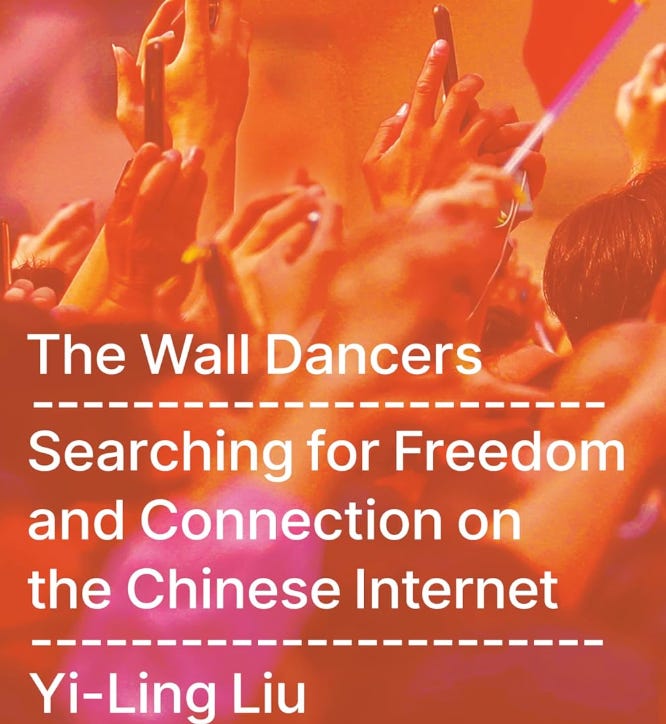
The Wall Dancers: Searching for Freedom and Connection on the Chinese Internet
Yi-ling Liu
Knopf
June 3, 2025
335 pages
ISBN-13: 978-0593491867
YI-LING LIU'S The Wall Dancers is a highly readable—borderline novelesque in its deft storytelling technique—account of five Chinese lives transformed by the internet and by their own courage in navigating it.
The author, a Hong Kong-born, US-educated journalist who built her career in Beijing, positioning her to write about China's internet with both intimacy and critical distance, has written a book that undermines the assumption that there are no secrets in the realm of China’s monolithic internet. Rather, Liu makes her case that the Chinese internet offers non-party-endorsed civic spaces for the marginalized via five Chinese: Ma Baoli, a gay cop turned dating app founder; Lü Pin, a feminist activist; Eric Liu, a Weibo censor; Chen Qiufan (Stanley Chan), a sci-fi writer; and Kafe Hu, a hip-hop pioneer.
What it takes—and here’s the book’s title and theme in a nutshell—as the author put it herself in a recent interview with Reuters, is the ability to operate in the mainstream and speak the language of authority. Liu adds, speaking of her subjects:
They could code-switch, they could wear many hats. They were creative and adaptable and knew how to identify leverage points for change.
They were, to take a saying that resurged in popularity with Chinese journalists in the 2000s, able to “dance in shackles” (带着铁链跳舞), or cleverly improvise within imposed boundaries.
A side note, a detail now far easier to dig up given the advances of AI, is that “Dancing in shackles” (帶著鐐銬跳舞1) appears to have had a previous time in the sun a century ago, when Wen Yiduo (闻一多), the modernist poet and scholar, argued in a 1926 essay that true poetic mastery lies in working creatively within constraints.
But the lineage barely matters. What counts is how aptly it describes Liu’s subjects: people who neither submit nor rebel, but find the gaps and test the limits, create civic spaces where there were none before.
Liu writes that, on returning to China, as she watched people constantly test and adapt to the shifting boundaries of the Great Firewall, she realized that some were particularly adept at pursuing expression and making connections without fully escaping the system or directly confronting it. As she put it in an interview with The Wire China: “I came to know the people who were really good at navigating this terrain as ‘wall dancers’, which is what ended up being the title of the book.”
The term matters because it resists easier labels. “Dissident” implies open confrontation; “netizen” is too neutral. Wall dancer captures something more pragmatic and more human — ingenuity under constraint, not heroic rebellion.
The early pages of the book inevitably coincide with the early days of the internet—the raw early days of Chinese internet access, when the technology itself was the crack in the wall. The internet as accidental liberator, before anyone with Party membership and clout had quite decided what to do about it.
In a particularly moving early scene, Liu writes:
The Internet begins in China as a place of discovery, filled with a sense of anarchic, joyful possibility. As a closeted policeman in the 1990s, when homosexuality was designated a mental disorder, Ma Baoli went to an Internet café, looked up the Chinese term for homosexual, and discovered a like-minded community. He read queer fiction, joined gay chat rooms, watched every gay film he could get his hands on, “sobbing over his takeout noodles,” and felt like “he was no longer alone.”
Ma, in what is one of the book’s highlights, goes on to build out China’s biggest gay dating app after being forced to quit his day job as a cop.
Liu also introduces us to the feminist writer Lü Pin, who becomes obsessed with the case of Deng Yujiao, a waitress who fell afoul of the authorities. Liu writes:
On May 10, 2009, Deng Yujiao, a twenty-one-year-old waitress in Badong County, Hubei [Province], was washing her clothes in the restroom of Dream Fantasy City, a karaoke and entertainment club where she worked, when two local officials walked in demanding “special services”—a euphemism for sex. Deng refused.
‘Aren’t you all the same? You’re a prostitute and you still want to have a good reputation?’ one of the officials taunted. He slapped her face with a wad of banknotes. ‘Don’t you want money? Would you believe if I am going to beat you to death with money today?’ When Deng tried to leave the room, he dragged her back, pushing her onto the sofa. Unable to struggle out of his grip, she pulled out a fruit knife and stabbed the three-inch blade into his neck. As he lay dying, she called the police and turned herself in. After her arrest, she faced homicide charges.
In times past, the case would undoubtedly have been classified as an “internal” affair and have vanished from the public eye without trace—another inconvenient incident silently vanished. But in 2009 China’s internet was a lively town square in which a blogger could pick up a racy local story and possibly take it countrywide. In the Deng Yujiao case at least one blogger did just that—and at the moment when China had overtaken the US and had more internet users than any other country in the world; an estimated 338 million in mid 2009.
Within days it was a national cause, with internet voices demanding justice and turning their anger on the officials involved. How, does a local cadre walk around with that kind of cash? was one question, implying the omnipresent Chinese career-killer, corruption. The other was whether Deng had acted in self defense.
The clamor of voices did its job. In what can only be seen as a staggeringly unusual change of fortunes the murder charges were dropped. Deng was granted bail on grounds of self-defense.
Lü Pin watched it unfold and when she responded, it was with a different take. The online conversation had focused on corruption, she wrote, when the real issue was patriarchy: a systemic tolerance of sexual violence that allowed powerful men to prey on vulnerable women.
Her articles found a readership, but a narrow one—the same small circle of scholars and academics who already knew her work.
Frustrated with preaching to the same flock of academics, in September 2009—just two months after the Deng Yujiao case—Lü founded “Women’s Voices,” a digital magazine dedicated to covering women’s rights issues, sent out as an email newsletter distributed weekly as a Word doc to her friends and peers. The magazine’s purpose, she wrote in the first issue’s introduction, was to “popularize China’s feminist movement.”
She didn’t want to create a closed circle of elite experts. She wanted to create a collective movement of grassroots feminists. A reader suggested a name change: “Feminist Voices” rather than “Women’s Voices.” At first, she hesitated. The word “feminism,”(nüquanzhuyi, 女权主义, literally means “women-powerism,” a likely red flag to likely to antagonize China’s more reactionary male readers. How would ordinary readers respond?
Readership soared and Lü, propelled by the internet, was suddenly the publisher of the nation’s most influential feminist publication, and herself China’s most influential feminist activist.
This review hasn’t touched on any of the other three characters whose individual stories weave together as the chapters unfold: science-fiction writer Chen Qiufan; hip-hop pioneer Kafe Hu; and Eric Liu, a former content censor turned critic. But as the reader proceeds, it becomes clear that the trajectories of all five’s aspirations follow the same pattern. As the cracks in China’s internet start to close—or is it that the chains drag heavier?—they start being forced into compromises and the reader starts to wonder how Liu can maintain all the way to the book’s conclusion the determined optimism that has fueled her narrative so far.
The answer is she does and she doesn’t. Two of her subjects, one of them Lü, do the “run”—to borrow the Chinese internet slang for getting out of China—and are in the US. Chen Qiufan is a science fiction writer success story, president of the World Chinese Science Fiction Association.
What about Ma Baoli, the closeted gay cop?
He quit his job, divorced his wife and established China’s leading gay dating app. Liu writes:
When we last met in 2021, he was leading a team of eight hundred people out of a two-story glass-walled office, preparing to list the world’s largest gay dating app on NASDAQ. Today, he operates from a cluttered office the size of a two-bedroom apartment with a dozen friends, devising business strategies to sell jackets and snacks.
Liu reports that Ma still has “bigger ambitions.”
The author should be commended for not giving up on her subjects—indeed the show itself—but the critical reader is likely to feel compelled to respond that The Wall Dancers is arguably a book about an era that has passed, particularly as we enter a new era of AI assisted censorship. Liu herself, in her epilogue describes writing the book as “a race against disappearance.”
The remains of a more open internet were and still are being quietly removed.
As the book concludes, Liu is in New York, where she meets Susan, 27 and from Jiangsu Province. Susan’s last job was with an NGO in Shenzhen until the do-good community work was shuttered by the authorities. She now “freelances.” She describes New York as “a breath of fresh air” but plans to return to China, despite the challenges.
At Liu’s probing, Susan says she thinks that Chinese who decamp to the US become too pessimistic about there being space to work on passion projects in China. For Susan herself, China still calls to her: there’s work that needs to be done.
In her interview with Reuters, Liu says she wanted to avoid the tired old trope of monolithic China and “do something different by telling the story through people, because it kind of forces us out of those tropes and forces us to really see a society in the full complexity of an individual human life.”
Framed so, Liu’s book is a highly readable success. But on the question of achieving meaningful change in an AI-assisted surveillance state, The Wall Dancers offers us some past glories in the form of five interesting Chinese who were fortunate enough to find internet wormholes to new lives before the CCP did their “Chinese characteristics” act and made shopping discounts the major surprises on a repurposed Web.
The discrepancy between the modern 带着铁链跳舞 and the 1926 帶著鐐銬跳舞 being the equivalent of “iron chains” in the modern version and “fetters” in the traditional-character poetic version.