


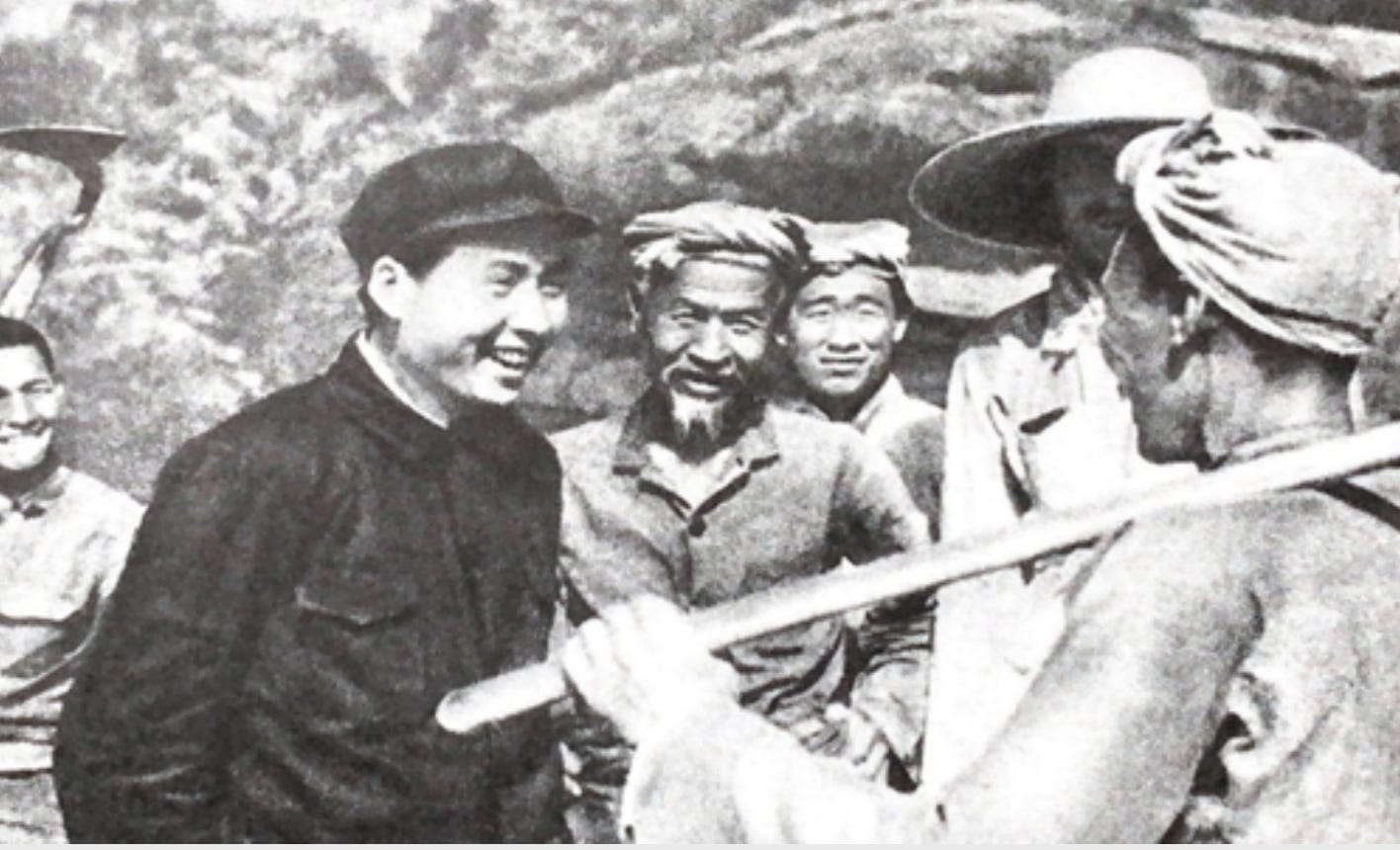
COMMON CHINA-WATCHING LORE has it that red flags flew and every “peasant” in China celebrated when Mao Zedong announced the founding of the People's Republic of China on 1 October 1949.
It was only after Mao and his fellow rebel long-marchers had risen to power that they ran China to ruin. That ruin, as anyone familiar with his work, will recognize as the abiding preoccupation of Frank Dikötter's published career.
In 1985 I traveled the length and breadth of China — Guangzhou to Beijing via Shanghai, then overland by slow train to Qinghai and by bus all the way to Tibet, and onwards to Kathmandu. I was a young British/Australian who studied Chinese at Melbourne University, primed by the usual syllabus, carrying the usual freight of received ideas about what the People’s Republic was and what it represented.
But I was discomforted by what I had seen in China. It was not a liberated people’s utopia. It was a traumatized nation — visibly, unmistakably, in its bones. I did not meet a single person in months of travel whose lot they took pride in, that they saw as something to be envied. My Chinese was clumsy then, but it was good enough to understand the stories of lives turned upside down and careers ruined, run to the bone by one mass movement after another.
It would take years more — living in Taiwan, working as a translator, writing Lonely Planet’s China guides (among others), accumulating the slow sediment of professional experience across the sinosphere — for my thinking about the CCP to recrystallize into something I could articulate with confidence: that liberation was a disaster for the Chinese people. It was the reason that liberation could never stop tilling and re-tilling the loam of its own history, purging itself with the aim of straining toward a social paradise that had never existed — one that Edgar Snow, shoulder-to-shoulder with his CCP comrades, had dreamed it to be.
It was all there for me to see in 1985. A grubby power grab with a grab-bag of Marxist tools foisted on a people who had no meaningful say in the matter. “Liberation” ill-planned, ill-conceived and, from the moment of its proclamation, systematically lied about.
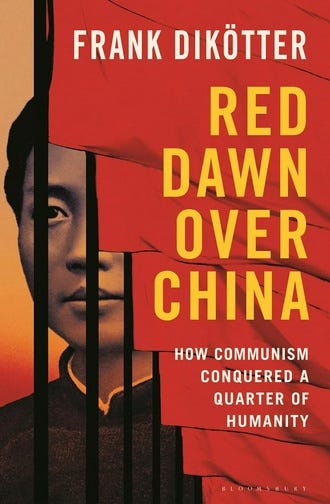
Red Dawn Over China: How Communism Conquered a Quarter of Humanity Kindle Edition
Frank Dikötter
Bloomsbury Publishing
February, 2026
384 pages
ISBN-13: 978-1526670687
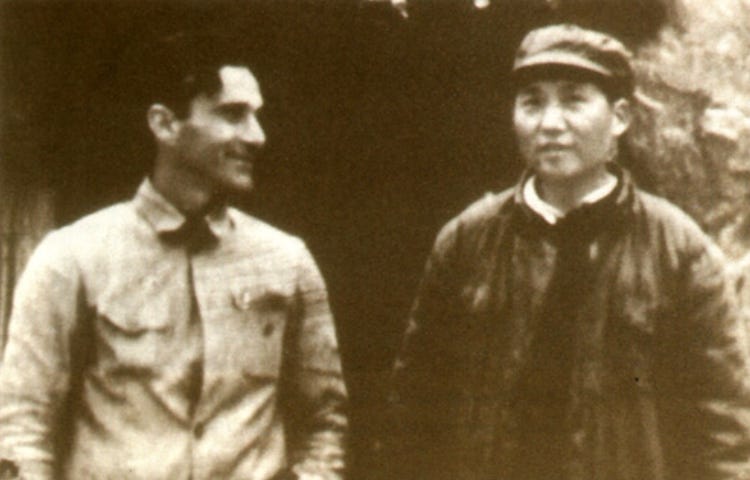
EDGAR SNOW ARRIVED in Yan’an in 1936 and found exactly what he was looking for: a shoestring paradise of ideologically driven brigands on the edge of China’s vast western loess plateau armed with little more than a dream and the excitement of youth who wanted to make revolution.
Over to Dikötter:
Snow presented a ragtag group of red soldiers entrenched deep in the hinterland as a more viable alternative to the central government with its 1.7 million troops. Mao was the leader-in-waiting in a war of resistance against the Japanese invader. It was all hubris. Red Star over China, a book-length account of Mao and the Communist Party, followed a year later, becoming an instant bestseller, translated into many languages. The book made Mao into a household name and became the basis for all subsequent accounts of the rise of the Communist Party, and by implication of the history of modern China. It is, at heart, a romantic tale of Communists fighting in the hills for freedom, a David and Goliath story in which sympathy goes to the boy with the sling.
What Snow could not see — or would not see — was that the dream was the point. The ideology was the recruitment tool, the archive of promises that would be broken as soon as the power was secured.
Snow, in Dikötter’s reading, was neither stupid nor malicious. He was seduced, as intelligent people are seduced, by a narrative that was purpose-built for seduction. The fact is that during the period in which the world became spellbound by Mao and his small army of brigands, that very same romantically bound grouping of compatriots had not won over China. In fact, in such a vast and populous nation, to call them even marginal was a stretch. As Dikötter puts it:
Almost every European country, with the exception of Nazi Germany, boasted a larger number of Communists as a proportion of their overall population than any province in China. Even Portugal, despite ferocious repression under António de Oliveira Salazar, had some 25,000 members in 1934, or one person in 280, while in China before 1940 the figure was no more than one in 1,700, even if we accept the vastly inflated figures provided by the Comintern (the abbreviated term for Communist International, an organisation set up in 1919 in Moscow to promote worldwide revolution).
The arithmetic is unforgiving. A movement this marginal, this unloved in its own country, had no business surviving — let alone winning. What kept it alive was not the revolutionary ardor of the Chinese peasantry but a lifeline from Moscow that ran, with occasional interruptions, from the party’s founding in 1921 to the moment the red flag went up over the Forbidden City in 1949.
The Comintern’s role was not merely inspirational. It was financial, organizational and military. Soviet advisers helped build the party’s early apparatus. Soviet money kept it functioning through years in which it could not have funded itself from domestic support alone.
And at the critical moment — August 1945, when the Soviet Red Army swept into Manchuria in the final days of the Pacific War — Moscow delivered its most consequential gift of all: the captured weapons arsenals of the Japanese Kwantung Army, transferred not to Chiang Kai-shek’s Nationalist government, the internationally recognized authority, but to Mao’s Communist forces. The military balance between the two sides, painstakingly established through years of civil war and Japanese occupation, shifted almost overnight.
The Japanese had, in this sense, done the CCP a favor it could never have arranged for itself. Eight years of brutal occupation had exhausted and delegitimized the Nationalist government, drained its best troops, and pushed the rural population to a point of such desperation that almost any alternative seemed preferable. The Communists, husbanding their strength in the hills while the Japanese ground down their enemies, emerged from the war in far better shape than the nominal victors. They then inherited the Japanese arsenal courtesy of Stalin, and the rest, as the CCP never tires of reminding everyone, is history.
Dikötter’s contribution is to insist that this history be read as it was, not as it was subsequently packaged. The revolution was not inevitable. The mandate was not popular. The victory was contingent on decisions made in Moscow, on the catastrophic overreach of Japanese imperial ambition, and on the systematic failure of the Western powers — Snow’s romantic dispatches very much included — to read what was actually happening.
To return to my own story, my own relationship with China, sadly Dikötter wasn’t publishing in the early years of my China education. I would have devoured his work after my first wide-ranging visit to China, because I already knew, in an inchoate, grasping-for-understanding sense – that sense before the words can manifest themselves coherently – that everything that I’d thought I’d known about the PRC was piecemeal, a mess of scribbled notes based on received wisdom defied by historical reality as far as we can now piece it together.
Frank Dikötter, a historian at the University of Hong Kong and Stanford’s Hoover Institution, is best known for the People’s Trilogy — Mao’s Great Famine (2010), The Tragedy of Liberation (2013) and The Cultural Revolution: A People’s History (2016) — three volumes that count the human cost of CCP rule from “liberation” through to Mao’s death. The first volume, which put the death toll of the Great Leap Forward famine at 45 million, won the Samuel Johnson Prize, now known as the Baillie Gifford Prize for Non-Fiction, an annual British book prize for the best non-fiction writing in the English language.
It also made him the most formidable archival challenger to the CCP’s self-serving historical narrative – and at the same time academically polarizing in the way that only genuine disrupters become polarizing: not because he was wrong but because he was highly inconvenient.
Red Dawn Over China is the prequel to the People’s Trilogy. Red Dawn is the book that revisits the crime sites to ask how the CCP criminal enterprise was assembled in the first place. It is, in some respects, Dikötter’s most ambitious – and arguably most essential work – precisely because it is operating in the PRC’s murkiest evidential waters and the CCP’s most hallowed and propagandized historical territory.
The crimes of the Great Leap Forward and the Cultural Revolution became, in time, statistically insupportable even to the regime’s sympathizers. But the founding moment — the revolution itself — retains a residual legitimacy in Western discourse that the later atrocities lost. Red Dawn is Dikötter’s assault on that residual legitimacy, and it is meticulously prepared for the assault it undertakes.
The methodological controversy that has followed Dikötter throughout his career deserves more than a brief nod before we proceed. It is true that he prosecutes his cases. He selects evidence with a verdict in hand, argues from the particular to the sweeping, and has a journalist’s instinct — not always a historian’s — for the memorable detail over the qualifying clause. An older generation of China scholars, reluctant to abandon more sympathetic readings of the Maoist project, charged him with cherry-picking sources and overstating conclusions his archive could not fully support. They were not entirely wrong in every particular.
Dikötter, after all, is unafraid to make bold conjectures based on his archival research and use language that many academics would frown upon. Take the following, for example, almost lifted at random from Red Dawn:
Whether scholarly volumes or popular books on the history of modern China, the narrative is all too often dominated by the Communist Party. At times it seems like a fairy tale: the country is racked by an unholy alliance of ‘imperialist powers’ and ‘reactionary forces’, the Communists mobilise the ‘peasants’ by taking the land from the rich and distributing it to the poor, then they gradually unite the people in their fight against the Japanese invader and the fascist Nationalist Party, their arch-enemy led by Chiang Kai-shek.
Pages later, the author is unafraid to unravel the “fairy tale,” pointing to everything that is buried in the CCP's will to proclaim the glories of a liberated China …
A whole range of alternative voices, including a rich tradition of democratic thought and practice that ran throughout republican China, has been relegated to the shadows after 1949. As in the story of David and Goliath, nobody remains standing except Mao, armed with ideological conviction, against Chiang Kai-shek, fascist leader of the corrupt and brutal machine of government. Huge chunks of history have been censored, are entirely unknown or remain untouched, and not just in the official historiography of the People’s Republic. One can search the secondary literature in English in vain [for retellings that counter the CCP version of history].
But crimes of omission – regardless of the skills put into the fairy-tale spell – have a way of coming out when they are of sufficient magnitude: and 45 million dead is of sufficient magnitude.
Complaints about prosecutorial sourcing begin to resemble a defense arguing chain of custody while the bodies are still being counted. The methodological debate has largely resolved in Dikötter’s favor not because his critics were wrong, but because the scale of what he documented made their objections peripheral.
That baseline credibility is what he now brings to Red Dawn — a period where the archive is thinner, the territory more contested, and the CCP’s self-legitimizing narrative still more intact. Which is precisely why the book matters as much as it does.
The central revelation of Red Dawn is how contingent the Communist victory actually was. The CCP’s own account presents 1949 as the inevitable culmination of a mass movement expressing the will of the Chinese people. What the archives, diaries, foreign dispatches and provincial records show is something closer to an organization with a talent for mobilization, an extraordinary patron in Moscow, and a political gift for promising whatever a given audience most wanted to hear.
The democracy gambit was the masterpiece. In January 1940, Mao and his ghostwriter Chen Boda penned “On New Democracy” — a tract pledging a multi-party system, democratic freedoms and protection of private property.
Dikötter comments:
‘On New Democracy’ … portrayed the Communist Party as a broad front striving to unite all ‘revolutionary classes’, including the ‘national bourgeoisie’, in the fight against imperialism and capitalism. China, Mao opined, was a semi-colonial and semi-feudal society demanding a revolution in two stages: first a democratic revolution, then a socialist revolution. The new democracy, he explained, was not the old bankrupt democracy dominated by a bourgeois minority so commonly found in capitalist countries, but a ‘joint dictatorship of all revolutionary classes’, a true majority protected by the leadership of the Communist Party.
It was, Dikötter writes, “an entirely fictitious program but one that held broad popular appeal, as many thousands of students, teachers, artists, writers and journalists joined the Communist Party in the following years, attracted by the vision of a more democratic future.”
One by one, the promises were broken. All organizations operating outside party control were eliminated in the first years of the new regime. A literary inquisition ensured that artists and writers conformed to party dictates. Books considered undesirable were burned in giant bonfires or pulped by the tonne. By 1956 all commerce and industry had become functions of the state. By the summer of 1958, people in the countryside were herded into People’s Communes — the land taken from the farmers, who were transformed, in Dikötter’s phrase, into “bonded servants at the beck and call of the state.”
The document had done its work. It could now be forgotten.
And here is the argument that Red Dawn makes possible in a way the trilogy could only imply: the CCP is not, and has never been, an ideologically coherent project. It is a power structure that wears ideology as a change of clothes — and has been changing clothes, with increasing desperation, ever since the Sun Yat-sen threads of old needed a fashion revamp.
Consider the never-ending purges. Every generation of CCP leadership has purged the previous one — not refined its doctrine, not evolved its thinking, but purged the people who embodied it and rebranded from scratch. This is not what ideologically confident movements do. Confident movements have heresies because they have orthodoxies worth defending. What the CCP has instead is a recurring identity crisis managed through violence and followed by a rebranding exercise presented, with straight-faced audacity, as ideological renewal.
Mao Zedong Thought. The Three Represents (Jiang Zemin, formally adopted at the 16th Party Congress in 2002). The Scientific Outlook on Development (Hu Jintao, adopted into the Party constitution at the 17th Party Congress in 2007). Socialism with Chinese Characteristics for a New Era (Xi Jinping, enshrined at the 19th Party Congress in 2017).
These are not philosophies. They are successive corporate manifestos designed to project power. The average Chinese did not know what they meant; educated Chinese knew that they were nebulous slogans and best left undiscussed in the interests of personal safety.
The latest manifestation, CCP General Secretary Xi Jinping’s “works” on governance, five volumes, approximately 2,500 pages, is not a governance manual in any recognizable sense. It is a compilation of speeches, instructions, letters and “conversations” — 470 pieces organized across 93 chapters, each volume interspersed with photographs of Xi at work and in daily life. At best it should be described as catechism – questions and answers that aim to instill doctrine in the faithful, implying a pre-existing coherent theology that the CCP has never possessed.
The CCP, after all, is still debating – it’s really no secret – what Marxism, or socialism, with Chinese characteristics is.
What’s more the target audience is not, in any meaningful sense, the Chinese people themselves. They are willing or unwilling subjects. Rather, the books are central to a concerted effort to promote single-party governance to Belt and Road partners across Africa, Latin America and beyond, with documents from China’s commerce ministry highlighting the authoritarian model as “central to the blueprint of successful development that others can emulate.”
In other words: the developing world, impressed by the high-speed rail and the GDP figures, is invited to consider that the party responsible for both might have something to teach all of them about how to run a country – and it’s a message that is especially attractive to authoritarian political elites.
What Xi’s tomes – arguably one of the vastest self-publishing vanity projects in human history – actually resemble more closely is something between personality-cult manuals and corporate mission statements — the kind of documents in which the authority of the author eclipses any reach for coherence.
The closest analogue in the authoritarian tradition is probably Mao’s Little Red Book, which had the same function: not to articulate a philosophy but to demonstrate, through sheer repetition and ubiquity, that the leader’s thoughts are definitive of the finest thinking the ultimate system can express. An alternative is Muammar Gaddafi’s Green Book — another slim volume of grandiose emptiness dressed up as political theory, distributed globally as though it contained ideas.
The private face of this vacancy surfaces in the archive with startling clarity. Here is Zhao Ziyang — praised to this day as the most promising reformer the party ever produced — addressing the Party Congress in October 1987: “we will never copy the separation of powers and the multi-party system of the West.”
Several months earlier, he confided to Erich Honecker, the leader of East Germany, that once living standards had been raised, people in China would acknowledge the superiority of socialism — and then, he added, “we can gradually reduce the scope for liberalization further and further.”
What gives Red Dawn its particular venom – clean of “told-you-so” bitterness – is the American chapter, which is also, in a sense, the Snow chapter. Snow was the template. What Dikötter documents in the post-war decades is the same seduction operating at the level of foreign policy, with consequences considerably more serious than a sympathetic book.
Nobody believed that more consequentially than Jimmy Carter, who made human rights central to his 1977 inaugural address and cultivated personal relationships with Soviet dissidents from Sakharov to Sharansky — and remained silent when Chinese dissidents were crushed. Asked about Wei Jingsheng during a visit to China, Carter answered: “I’m personally not familiar with the case that you described.”
Wei Jingsheng, who had stood shaven-headed before a Beijing court in 1979 defending himself by pointing out that the constitution guaranteed freedom of expression, and received 15 years for the eloquence of that defense, would have certainly had a view on that.
The British do not escape either. Dikötter’s account of the Thatcher-Deng negotiations over Hong Kong is pointed. Deng made threats, issued dark warnings, and — hours after meeting Thatcher — told an intermediary that by taking over Hong Kong, Beijing would be able to extract more of its foreign currency. On returning to London, Thatcher concluded that none of the leaders in Beijing understood international finance or the concept of freedom under a system of law. She was right, and signed the Joint Declaration anyway.
Snow, Carter, Thatcher — and a procession of others who should have known better. The myth required collaborators, and it found them at every turn.
There is a further irony buried in the Reform era material that Red Dawn illuminates: the one genuine economic success story of the post-Mao period did not originate with the party at all. The dissolution of the People’s Communes, notionally a policy triumph of the reform leadership, was in practice ratified rather than initiated from above. As an East German embassy observer in Beijing noted at the time, the yearly documents on agriculture “only fix in writing what has already been achieved through a spontaneous process at the village level.” The sociologist Kate Zhou was more direct: “When the government lifted restrictions, it did so only in recognition of the fact that a sea of unorganized farmers had already made them irrelevant.”
The ideology did not drive the outcomes. It chased them — and then claimed credit. Which is, in miniature, the story of the whole project.
When the party finally convened in 1981 to draw a formal line under the Cultural Revolution, Deng Xiaoping intervened repeatedly to salvage Mao’s reputation. “Some comrades have pointed out that mistakes committed during the Great Leap Forward and the Cultural Revolution by far outweigh those committed by Stalin,” he acknowledged — before delivering the line that explains everything about how the CCP manages its own history: “To blacken Mao is to blacken our Party.”
That’s Dikötter spelling out the crimes detailed in the People’s Trilogy — how the myth was built, who paid for it, who believed it, and who at least pretended to believe it because the alternative was too dangerous.
The founding myth cannot be renounced because the myth is the party. There is nothing underneath it — no settled doctrine, no ideological bedrock, no vision of the good society that survived contact with the reality of governance. What there is instead is the story: the ideologically driven brigands on the borderland Silk Road loess plateau, the dream of liberation, the inevitable triumph of the people’s will. Edgar Snow’s story, still being told, with new characters and updated slogans, by a party that has never found anything more durable to replace it with.
What makes Red Dawn methodologically remarkable — and quietly devastating to Dikötter’s critics — is that its principal sources were never hidden. In the 1980s the CCP commissioned over 300 volumes of its own internal party documents, covering 1923 to 1949, restricted to senior members and never meant for public eyes.
They found their way across the border into Hong Kong, where they sat in university libraries and research collections — accessible to any scholar who cared to look, but largely unread by the field, for forty years.
When asked why no other historian had used them, Dikötter’s answer was characteristically dry: “Go and ask them. It’s not my problem.”
It is, however, very much the field’s problem — and Snow’s, retroactively. The counter-narrative to the CCP’s origin stories required no secret archives. It required only the willingness to look.
Dikötter has now given us the full arc: the crimes that are the substance of The People’s Trilogy, the air-brushed history that followed, and now, in Red Dawn, the seductive prehistory — how the myth was built and funded and who were its adherents – out of zeal or fear.
It is the indispensable first chapter of a story that is still unfinished, and a story that started in such a way that it can neither be forgotten nor dismissed.
But above all, please …
Super job, Chris. I have the book on my bedside pile and will bring it to the top now.
Thanks Sascha. Interestingly, so far, it's one of my least-read book reviews. Perhaps that's because it hits hard, perhaps I could have done a better job. But I like to think that the truth, or at least attempts to nudge at it, aren't all that popular. I'm going to put up a less hard-hitting review tomorrow.