


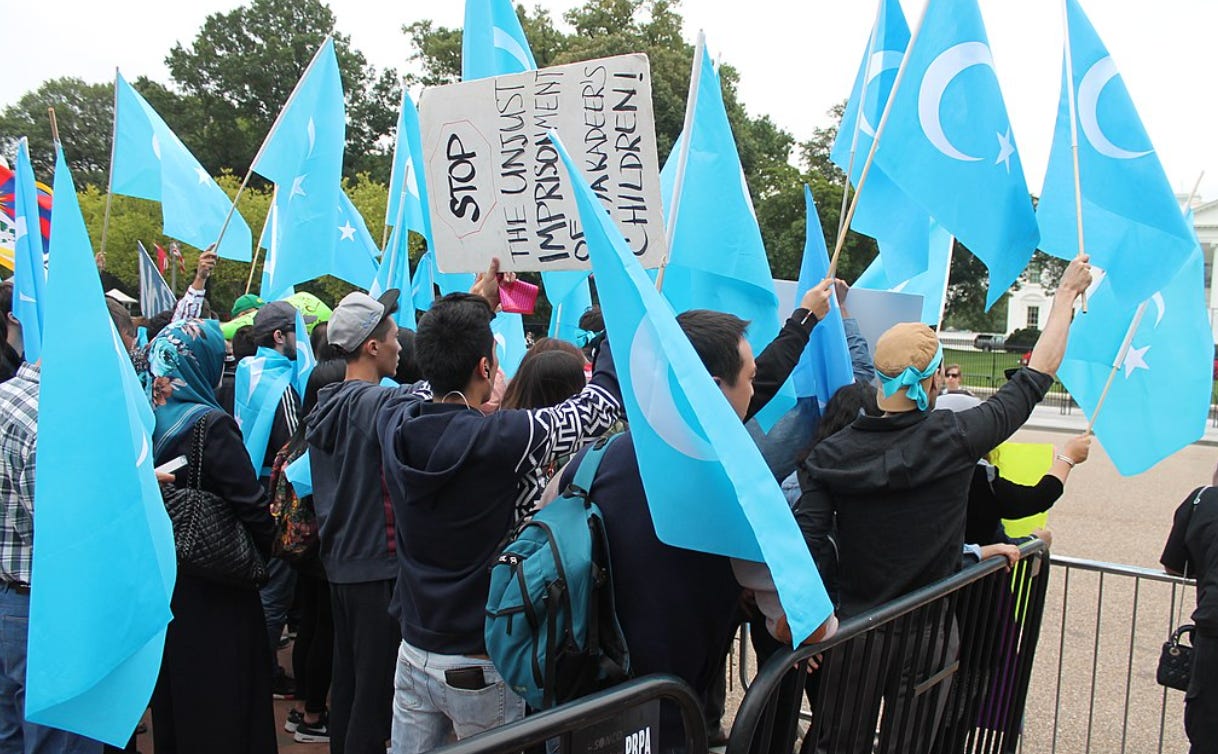
EMILY FENG’s Our Hearts Burned for Home is set almost entirely in northern Syria, where several thousand Uyghurs – a Turkic Muslim people of the old Silk Road oases – fought in the Syrian civil war and helped bring down Bashar al-Assad’s regime in December 2024. Written with the exiled Uyghur writer Abduweli Ayup, and based on nearly a month of interviews in Idlib in the summer of 2025, it is a short book about a long war. It is also, from first page to last, a book about China.
China haunts the margins of Our Hearts even when bullets are flying and mortars are exploding and the Uyghur fighters wonder whether they will ever be able to take their fight home. Especially then.
Choghtal, now second-in-command of the Turkestan Islamic Party (TIP), the largest Uyghur militia in Syria, first learned that his people “twice, briefly, had their own republic” – the East Turkestan Republics of the 1930s and 1940s from books in a state-run Xinhua bookstore. Moaz, jailed in the 1990s for printing pamphlets on Uyghur history, covered his prison uniform with poetry written in charcoal and drew fighter planes bearing the East Turkestan flag bombing Beijing. Unver, a former student, pictured Xi Jinping while learning to shoot: “I only remembered that pig in front of me.” Even in Idlib, the fighters treat a group of Mandarin-speaking “tourists” as Beijing’s spies and beat them bloody. When the war ends, China follows them to the negotiating table, with its UN ambassador warning about “foreign terrorist fighters” and Wang Yi, China’s foreign minister, pressing Syria’s new foreign minister to deal with them.
Beijing would say this proves its point, and it has said so. Feng notes that fears of Uyghurs “tapping into a global trend of Islamist-inspired armed resistance, fueled by the example of Uyghur fighters in Syria and Afghanistan,” were one of the reasons Xi gave for launching, in 2017, the detention campaign in Xinjiang, in China’s far northwest, which Uyghurs call East Turkestan.
Feng reads the evidence the other way. The fighters’ existence, she writes …
… is in no way a justification for the Chinese government’s policies of cultural annihilation in Xinjiang. In many ways, they prove that China’s ethnic policies do not work; rather than stamping out Uyghur identity, their policies instead seeded an armed movement of revenge that has played out across generations and across regions.
The men Feng interviews tell the same story about themselves. “I never decided to leave East Turkestan,” Choghtal says. “They forced me to leave. They drove us out.” For Moaz, the turning point came while he was tortured in prison:
“They treated us as people who would not listen to reason, and they tortured us. A regime like that cannot be convinced with words.”
Many trace their path to Syria to the July 2009 ethnic riots in Xinjiang’s capital – known simply as the Ürümqi riots – and the crackdown that followed. Choghtal even admits a grudging respect for his enemy’s methods: “They did not subjugate East Turkestan in one day; they did it step by step, with strategy and methodical tactics.”
The same assimilation policies have not produced the same result everywhere. Tibetans, facing comparable pressure, went into exile in India under a leadership committed to nonviolence. The Uyghurs, by an accident of geography and timing, had war zones within reach, first Afghanistan and Pakistan, which proved unworkable, then then Syria, which became both a training ground and a refuge.
As a Uyghur friend of mine who had grown up in China put it to me once many years ago: “Did you ever hear of a Uyghur burning themselves to death? Uyghurs, we fight back.”
FENG, AN NPR correspondent and author of Let Only Red Flowers Bloom: Identity and Belonging in Xi Jinping’s China (2025), has penned a rare treasure of a book – a view of China from the wars of the Middle East, from a cast of real-life characters who put their lives on the line to build new homes in exile, and with a common enemy who appears to belong to altogether another story.
Indeed, what makes the book stand out from most writing about the Middle East is who that enemy is. It is not the United States. Moaz, who passed through Pakistan’s tribal borderlands of Waziristan in the 2000s, found the Uzbek militants’ ideology “almost akin to that of ISIS” and their causes foreign to him. He felt no personal antipathy toward American forces, and Israel, he said, “had nothing to do with” the Uyghurs. When ISIS tried to recruit them in Syria, most refused. They had come, Feng writes, “to learn how to build a Uyghur state, not an Islamic caliphate.” Years on the front line wore down their religious absolutism too. “If you want to liberate your country, you do not need to fight with the people who smoke or drink alcohol,” said Zubeyr, once an imam. “You should be fighting against your enemy.”
By the end, the Uyghurs are courting Washington. “If the United States helps us, they help themselves,” Choghtal tells Feng, and he hopes Syria’s new rulers will “stand on the side of the West.” That they reached this point by fighting for years alongside groups with Al Qaeda roots is a contradiction the book records rather than resolves. Choghtal’s faith that Ahmed Al-Sharaa, Syria’s new president, himself a former al-Qaeda commander, will not betray them, and that America will want them, may prove naive. But in a region where America is usually cast as the hegemon, these fighters see the hegemon as Beijing.
Our Hearts is steeped in loss. When the Uyghurs rode into Damascus in December 2024, Syrians kissed their faces. “They made us feel we were beautiful,” said Anas, “and it was only when I looked in the mirror later that I realized how dirty we were.” Around him, men were weeping, not for Syria but for home. “I thought, if only it were Hotan, or Aksu, or Ürümqi,” Choghtal said, naming two oasis cities and the capital of Xinjiang. That night he promised, still in battle fatigues, to take the fight to Kashgar, the old Silk Road city.
Peace has not brought them closer to Kashgar. TIP has been absorbed into Syria’s army as the 84th Division, and its commanders hold posts in the defense ministry. There is talk of Syrian citizenship. Families have settled in villages emptied by the war, in houses left by fleeing Christians and Shiites, which the Uyghurs treated as war bounty, a choice Feng says “would come to haunt them later.” Nurmemet, back from Istanbul, has spent six thousand dollars on a modest new house, because, you never know when the call to attack China might come.
The children are the measure of how far away home has become. “We are raising our own army,” one commander says. But when Bilal asks his youngest daughter to point to home on a map, she points to Idlib. He moves her hand to Kashgar, and she points back to Idlib. “I think when I tell my children about East Turkestan, they think I’m just telling them made-up stories,” says Abdulhey, “as if they are not about real people or a real place.” Anas puts his hope in the next generation: “Even if we ourselves cannot achieve it, then maybe one day our children can.”
Feng does not say outright that the war will never go home. She doesn’t need to. Her subjects fought a war for regime change in a country that was not theirs, in the hope of one day fighting the same war at home. In the meantime their children have grown up Syrian.
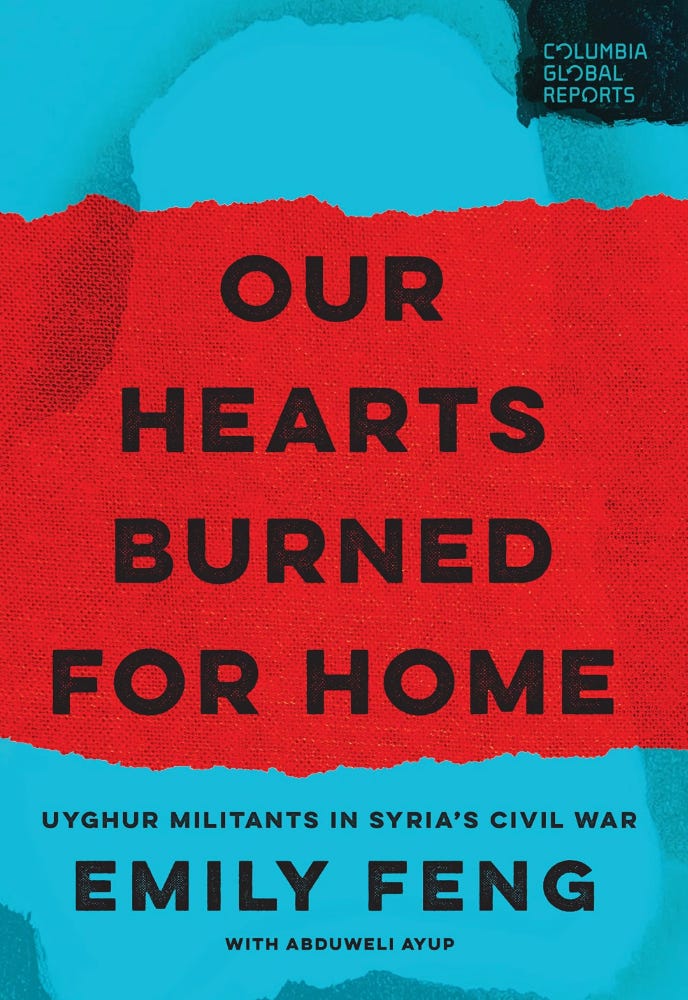
Our Hearts Burned for Home: Uyghur Militants in Syria’s Civil War
Emily Feng (with Abduweli Ayup)
Columbia Global Reports, 2026
128 print pages