


NEXT TIME a friend – or a random stranger, for that matter – takes it upon themselves to give you an extemporaneous lecture on the sagacity of China’s long-view leadership, refer them to Logan Wright’s Broken China. Better yet, read it to them. Very slowly.
Wright, who monitors the Chinese economy at Rhodium Group, dispels what he describes as “one of the most persistent myths about China’s political system” – that it cooks up “complex long-term plans and strategies to achieve Beijing’s political objectives.”
Henry Kissinger is partly to blame, the author writes.
[Kissinger’s] famous invocation of Zhou Enlai’s response in 1972 when asked what he thought of the French Revolution – that it was “too early to tell” – reinforced this perception of the long-term thinking of China’s leadership. Never mind that Zhou actually thought the question was referring to the more recent 1968 demonstrations in France.
Wright argues that China’s investment-led growth model is bust – “broken” in his words. In short, the financial system that once facilitated China’s economic growth now constrains it. The policy tools the leadership had at its disposal when China went into full credit expansion mode in the aftermath of the 2008 global financial crisis (GFC), he maintains, no longer work.
In Wright’s telling of what happened when the music stopped – signaling the end of the biggest credit boom in history – Beijing essentially lost control of the levers that control the economy.
The property sector, which represented a quarter of the economy before the bubble burst, made up nearly 70 percent of household wealth. The destruction of much of that wealth has led to a plunge in consumption. Prices and sales continue to fall, while local government is mired in debt – much of it hidden – having been highly dependent on land sales to property companies. Investments in infrastructure are increasingly unproductive. Youth unemployment is soaring.
LIKE OTHER ANALYSTS, Wright agrees that China’s economic rot began when home buyers with weak credit in the US started defaulting on subprime mortgages in 2007. The loans had been bundled into securities and sold to banks and investors worldwide. The losses spread everywhere at once, and when Lehman Brothers collapsed in September 2008, credit froze across the global financial system.
In China exports had fallen sharply by late 2008. Factories shut and migrant workers were sent home. A RMB 4 trillion rescue package materialized in November that year. Banks were told to lend. Lend they did.
Arguably, China’s credit machine had been pumping strong before the rescue package. Credit had been growing fast through the 2000s. What changed, starting in late 2008, was scale.
Over to Wright:
China’s policy response was … larger than any other economy’s. Over … [the] eight years after the financial crisis, China’s banks extended credit equivalent to an astonishing one-third of global economic output. This was the largest expansion of credit in a single country over a similar timeframe in more than a century. China’s total credit expansion from 2009 to 2016 was around five times the size of the expansion in US consumer credit that had driven the subprime mortgage crisis in US dollar terms
This torrent of credit built much of what the world now pictures when it thinks of modern China. It paid for the world’s largest high-speed rail network, with bullet trains running between cities that had barely heard of each other a decade earlier. It paid for entire new districts on the edges of third- and fourth-tier cities, such as Ordos in Inner Mongolia, where wide boulevards, museums and apartment towers stood waiting for residents for years. It inflated a housing market in which couples couldn’t afford a flat while investors bought empty apartments and left them dark.
It spilled into the stock market, which surged and crashed in 2015, and it ran through shadow banking, where wealth management products (WMPs) offered returns no bank deposit could match, and through peer-to-peer (P2P) lending platforms that took in ordinary savers’ money until P2P lending collapsed and the victims ended up protesting outside the banking regulator in Beijing.
The entire stack of cards teetered on the same borrowed money. The cities, rail lines, boom towns and scams were all, arguably, one story.
THAT STORY ended abruptly in 2016 with a message in the People’s Daily from the party to the people:
On May 9, 2016 … when the paper carried an interview entitled “Asking About Big First Quarter Trends – An ‘Authoritative Person’ Discusses China’s Economy,” the messages from this “authoritative person” were clearly indicative of views from Party leaders. The message was unmistakable: China’s model of leverage-fueled economic growth needed to end, and quickly. “A tree cannot grow to the sky, and high leverage carries high risks.”
Unfortunately, what happened next, effectively, in Wright’s words, began “strangling the future” by way of rolling over credit to “unproductive state-owned enterprises.”
From late 2016 into early 2018, Beijing launched a deleveraging campaign. It tightened monetary conditions, restricted specific shadow banking products and the accounting tricks behind them, and reorganized the regulatory bureaucracy to bring informal lenders under tighter control.
Wright’s view is that the shadow banking system had grown far larger than Beijing realized, so curbing it hit the whole financial system. Credit growth, which had averaged 17.5 percent a year from 2009 to 2016, fell to 6.8 percent in 2018, and credit to companies dropped by about two-thirds, mostly to private firms, while households kept borrowing through mortgages.
By Wright’s reckoning, when half the borrowers in an economy lose access to credit, output, jobs and investment get cut – and indeed that is what happened from 2018 onward.
Politically, Wright argues that under Xi Jinping, China has moved from a gradualist, consensus-driven technocracy to a centralized decision-making structure, in which loyalty and ideology count for more than competence.
Slogans like “common prosperity,” “the great rejuvenation” and “the East is rising and the West is declining” now came to set the policy agenda. The economy needed restructuring, but restructuring would cost growth in the short term. Restructuring would hit the Party’s own constituencies and contradict the story Xi had staked his name on. As a result, the leadership started to react to events, lurching from campaign to campaign, and putting off hard choices.
As Wright has remarked elsewhere, “I think that anyone who’s looked at Chinese economic policy at a very granular level over the past two decades has a really hard time making the argument that this all followed a long-term grand design.”
Meanwhile, Xi’s centrality to China’s post-bubble world has, according to Wright, introduced an entirely new element of risk to the economy. He cites the 2020-21 crackdown on giant tech firms, over the course of which investors in China’s tech platforms, starting with Alibaba’s Ant Financial, found themselves – as opposed to getting the ROI they’d expected – the target of a political campaign. Xi’s “rising China” narrative, in the meantime, had become such an imperative that it made China’s economic numbers a sensitive issue.
In contrast with Beijing’s official 5% GDP growth rate in 2025, for example, Rhodium puts real growth at short of 3%. For 2026, Rhodium states, “For domestic demand to lift China above 2% GDP growth in 2026, Beijing must reverse the systemic causes of household and business malaise.”
TODAY, WRIGHT CONTENDS, growth in China’s domestic economy is being sacrificed at the altar of capital-intensive manufacturing of new technologies, such as electric vehicles, solar photovoltaics, AI and robotics, which offer little in the way of jobs for the growing ranks of unemployed. With consumption slumping within China, demand has to come from abroad:
Unless domestic demand in China improves significantly, China’s investment-led growth model now depends upon claiming a larger share of a shrinking pie of global demand, while forcing other countries to disinvest or shut down their own factories. In the current pattern of investment-led growth, China can only continue growing its economy if other countries reduce their own investment, economic growth, and employment.
China’s factories now make far more than its own households can buy. Local governments collect value-added tax on output, land, energy and inputs are cheap, and banks keep lending to firms that can’t repay, so capacity keeps growing whether or not anyone wants the goods.
The surplus goes abroad – and China has more surplus than anyone else.
Wright’s example is solar, where China expanded capacity twice as fast as the rest of the world between 2010 and 2015 and polysilicon prices fell 70 percent, pushing many producers elsewhere out of business. Electric vehicles, better known as EVs, are the current case, and robots will likely be next.
For Europe and the US the result is potential deindustrialization in sectors tied to national security, and dependencies that can be weaponized.
That is the threat Wright wants readers to focus on. In a China Considered interview with Elizabeth Economy, he says the rivalry with China is not a long-term contest over economic performance but “a short term rivalry based on this deindustrialization threat from Chinese exports.”
By way of consolation, Wright concludes on a hopeful note – at least in terms of the interests of Western democracies.
Five years ago, he says, the fear was that China would become the world’s largest economy, which would have magnified every other threat. Now, he says, the US and Europe have more options and should use them collectively. The West should challenge the inevitability of China’s rise, since it anchors Chinese diplomacy in the Global South.
Wright argues that, if this is done, at some point Beijing will start “paring back” and looking for concessions. “If China’s not going to be a source of growth,” he says, “then the benefits of trading with them are far more limited.”
Of the argument that Washington can do more to make that case, he says: “That’s one thing I hope that people take away from the book.”
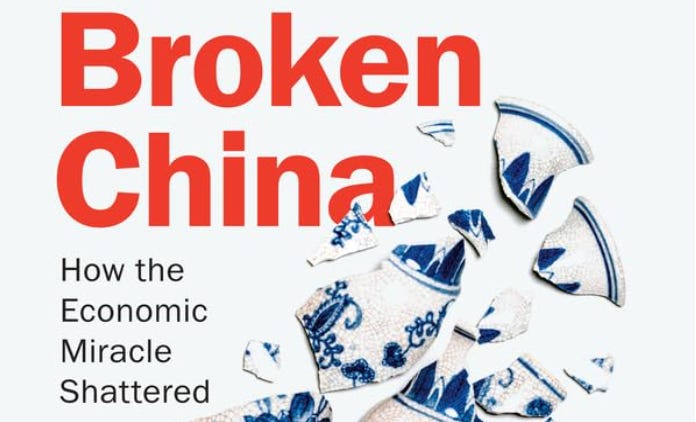
Broken China: How the Economic Miracle Shattered and What It Means for the World
By Logan Wright
Publisher: Polity
Print length: 272 pages