


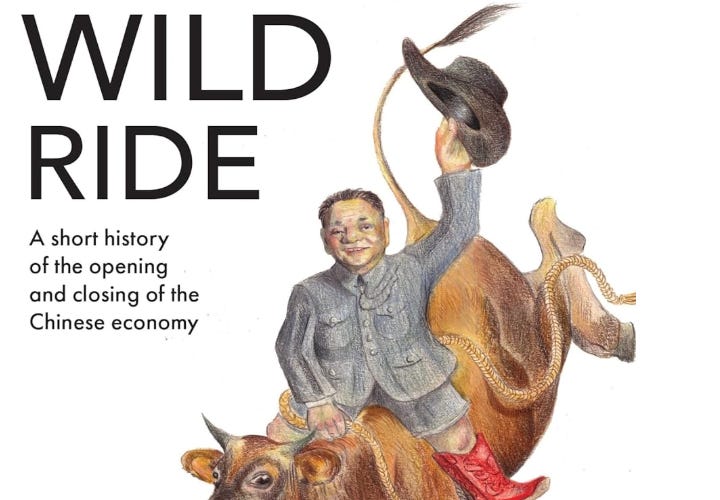
Wild Ride: A Short History of the Opening and Closing of the Chinese Economy
Anne Stevenson-Yang
Bui Jones Books
June 3, 2024
144 pages
ISBN-13: 978-1739424367
YET ANOTHER late-to-the-table-review, Anne Stevenson-Yang’s Wild Ride: A Short History of the Opening and Closing of the Chinese Economy should have appeared here in ChinaDiction last year. But, given the wide-ranging nature of the book—and within less than 150 pages—it was never going to claim the attention that bigger books with bolder themes do.
That’s a pity—and unfair. Wild Ride is not a book in search of a theme. It’s simply a book in which the theme comes most easily to the reader whose mode is set to “slow/thoughtful.”
Stevenson-Yang’s case is also hampered by the fact that she arguably saw the light too soon, selling her Beijing home in 2011, when she saw the writing on the property-market wall. The truth is that the writing was there—it just wasn’t to manifest itself as a pop for another 10 years. The miracle story—although not Stevenson-Yang’s—is how long Beijing kept the entire wobbly infrastructure steady for as long as it did.
Her core thesis about the bubble’s unsustainability—over-supply, debt-fueled speculation and illusory value in en-masse vacancies—proved prescient, but her timing was off by a decade due to government interventions, stimulus, and policy efforts to prop it up (e.g., easing credit cycles).
Arguably, such outcomes are all part of the “wild ride,” which returns us to that theme lurking in the background of Stevenson-Yang’s tick-off-the-decades history of post-Mao China.
How often was China’s rapid rise interpreted as an ideological shift? At times it was almost as if every time a Politburo cadre sneezed in Beijing, democracy, peace and prosperity for all was around the corner. Wild Ride’s great strength reposes in its ability to see through the absurdity of such thinking and unflinchingly view China as a country in which regime survival trumps everything else. Wild Ride offers clarity on the extent to which China’s political elite was rattled by the events of 1989, when offering a form of democracy with Chinese characteristics took precedence over everything else.
In hindsight, asked whether China’s dazzling rise was a genuine ideological shift or a temporary, pragmatic concession in the existential interests of survival by the party, the answer by now should be obvious, particularly as General Secretary of the ruling Chinese Communist Party Xi Jinping digs in ever deeper with his self-reliant, tighten-your-belt world view.
Overall, Wild Ride argues that China’s dizzying ascent wasn’t tainted by a drop of ideological zeal. What we’re witnessing now is the winding down stage, acknowledging the miraculous growth that preceded it and its inherent unsustainability when authoritarian impulses take the lead from market forces.
At the heart of Stevenson-Yang’s analysis is real estate. While Deng Xiaoping’s reforms welcomed foreign capital and technology, the decisive spark came in the 1990s under Zhu Rongji, premier from 1998 to 2003. Undertaking bold economic reforms, tackling corruption and steering China through the Asian financial crisis and negotiating the country’s entry into the World Trade Organization, Zhu laid the foundations for China’s explosive economic growth and its integration into the global economy in the 1990s and early 2000s.
It’s a well known story now—the great feedback loop. Rising incomes meet repressed interest rates on savings. Local governments, starved by the tax system, turn to land sales and property-led development as their main revenue source. Through thousands of LGFVs backed by land collateral, authorities borrow enormous sums to construct roads, airports, high-speed rail, and, whatever else springs to mind.
The resulting credit boom—unparalleled elsewhere—drove double-digit GDP growth, generated massive household wealth via leverage, and created extraordinary fortunes for connected elites. Construction, speculation, and related sectors became the economy’s beating heart. But the model was brittle from the start, Stevenson-Yang argues—an “experiment” propped up by financial repression and state command rather than true market mechanisms.
Enter those infamous “ghost cities”—and with them, unfortunately, the non-ghostly debts. The 2008 global crisis prompted a stimulus that supercharged property further, and by the late 2010s the cracks were visible: unprofitable projects, price stagnation after 2019, tightened credit to developers, and a sharp drop in new home starts. The property collapse has since crippled local budgets and eroded consumer confidence.
Stevenson-Yang’s account is unflinching. It’s Wild Ride’s greatest strength: reform was never about political opening; it was a pragmatic bid for regime survival. As the writer puts it:
After Russia invaded Ukraine, analysts opined that China was building a new world order in competition with the US. None of these fears have been realized, yet two quite different constituencies internationally continue to stress the reality closest to their own interests: competitive, threatening China or admirable, cooperative China; one growing into a belligerent threat to world peace, the other encompassing a vast new market, which no foreign company can afford to ignore. Actually, neither view is accurate. The fear of China as a competitor is misplaced. But understanding China’s effects on the world economy and governance has only just begun.
The suggestion is that this isn’t about China triumphing globally—it’s about the corrosive demonstration effect. The world has now seen a large, poor country use authoritarian methods to become the second-largest economy, lift hundreds of millions out of poverty, and build world-class infrastructure, all while keeping the Party firmly in charge. That precedent is tough to unsee, especially when democracies struggle with infrastructure delays, inequality, polarization, or so-called short-termism.
Stevenson-Yang pairs this with skepticism: the “success” was partly illusory (built on debt, speculation, forced savings, environmental ruin, and suppression), and it’s now unraveling into stagnation and isolation, although such positions are debatable. The true fallout isn’t military conquest or ideological export—it’s the normalization of the idea that autocracy can deliver results worth the trade-offs in freedom and openness.
That’s what is hard to forget (and potentially destabilizing for global governance): autocracy can appear to “work” and “get things done” on a massive scale, at least for a while, without the liberal prerequisites that were for so long assumed essential. It’s the deeper, more enduring effect Stevenson-Yang is undoubtedly pointing toward.
That’s the one that outlasts the hype cycles of threat or opportunity—the framework of competition even. Its outcomes are unpredictable and reverberate long after people first become aware of them—often until they’re upon you.