


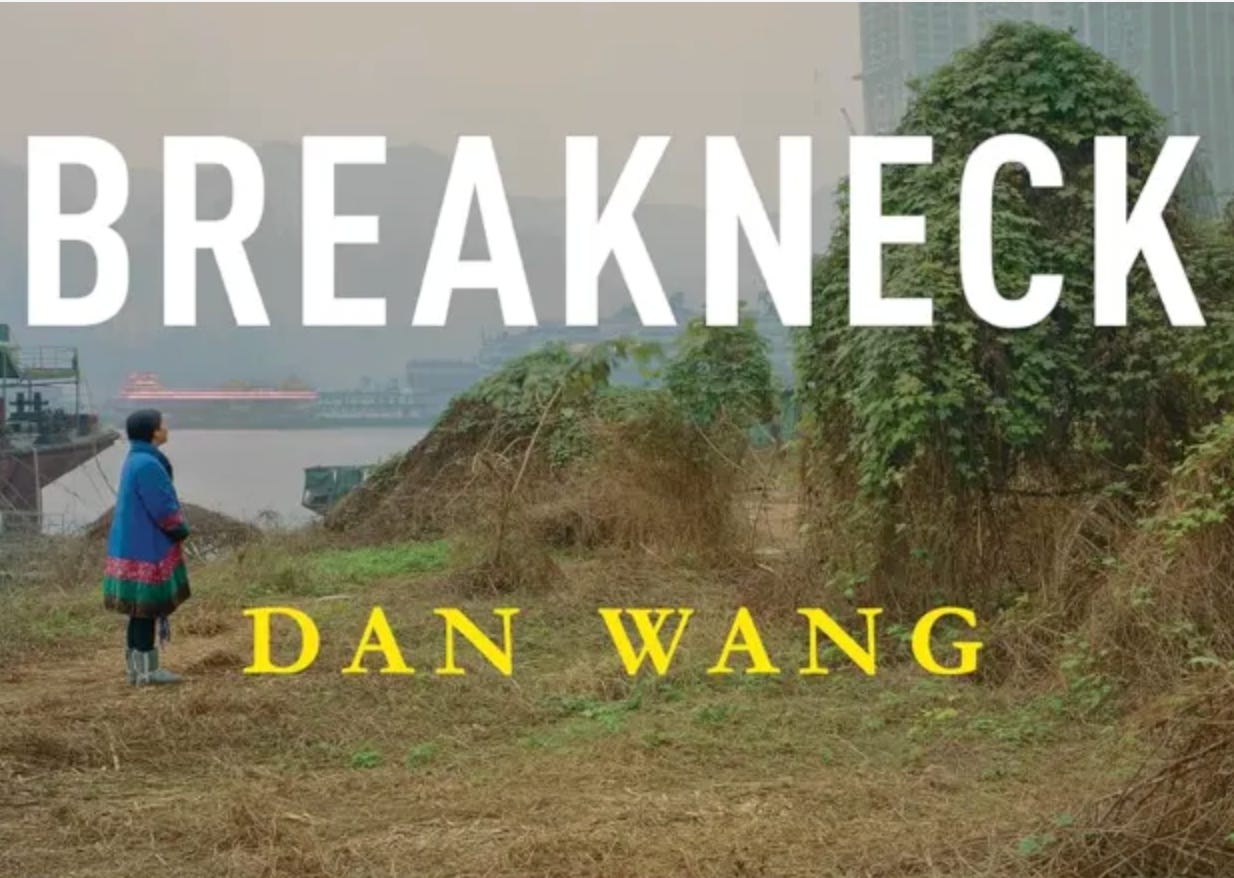
Breakneck: China’s Quest to Engineer the Future
Dan Wang
W. W. Norton & Company
June 3, 2025
275 pages
ISBN-13: 978-1324106043
DAN WANG’S BREAKNECK is a book with two premises, but let’s get the easiest of them out of the way first because it risks becoming an annoying meme with limited utility.
It goes like this: Americans and Chinese are far more alike than they realize. That’s it. If only Americans learned to love engineering slightly more (see Premise 2 below) and the Chinese upped their lawyerly restraint, the two global superpowers might stop glaring at each other across the Pacific and start learning from each other.
They might even begin to realize—as Wang puts it on the first page of his book—that there are “no two peoples … more alike” than they are.
Shouldn’t that spark mutual curiosity, Wang wonders—and isn’t mutual curiosity exactly what the world needs right now?
Over to Wang:
The best hedge I know against heightening tensions between the two superpowers is mutual curiosity. The more informed Americans are about Chinese, and vice versa, the more likely we are to stay out of trouble.
It’s rung a chime of hopeful optimism that has resonated, welcomed by rapturous critical praise and coveted book-of-the-year short-listings—notably the Financial Times, which shortlisted it as “Business Book of the Year.”
It didn’t win, and at the risk of engendering any ill will from the author, who’s a promising writer, it shouldn’t have. Breakneck is a fluidly written account of the author’s six or so years in China, with several borderline travelog digressions. Unfortunately, the book hinges on a conceit that the author has been living in an “engineering state,” and of all the many things China is, I’d argue that the engineering is a veneer—a veneer with heavy clout, shouting at you from urban sky-scapes and offering a plenitude of intra-China travel options, but a veneer all the same.
By comparison, the previously mentioned distraction of posited US-PRC affinities—no two people are more alike—is minor compared to the argument that a surfeit of engineering degrees has shaped China in ways that work to China’s advantage and our disadvantage. They’ve been building up and out, while we've been lawyering up and stymying high-speed rail and shiny urban commuter options with years of paperwork and all the NIMBY zeal we can muster..
To be fair, Wang, playing it cool—“just kidding” (wink, wink)—has subsequently described Breakneck’s intent to the Commonwealth Club World Affairs of California as “playful and provocative.”
He may say that, but he gives every impression of genuinely believing that US “lawyerly society” could do with a nuts-and-bolts “engineering state” kick on the posterior, while the latter should keep its grubby fingers at a considered remove from the human soul, which won’t happen because talk of the soul alone is enough to warrant tea with the local constabulary, if not worse.
But Wang is clearly disturbed by the party’s ruthless overreach—in the name of progress and patriotic nationalism, for example—in his chapters on the country’s zero-Covid strategy and the One-Child policy.
He writes phlegmatically:
The fundamental tenet of the engineering state is to look at people as aggregates, not individuals. The Communist Party envisions itself as a grand master, coordinating unified actions across state and society, able to launch strategic maneuvers beyond the comprehension of its citizens. Its philosophy is to maximize the discretion of the state and minimize the rights of individuals.
It’s a statement that speaks to Breakneck’s overarching vulnerability, whispering, What if it’s something more than that? It is a communist party, after all—a communist party that bulldozers over anything that stands in its way and outright bans any expression of civil society, be that religion or even Marxist discussion groups.
There it is: what Wang celebrates as having achieved eye-popping engineering accomplishments the length and breadth of China is inseparable from the bulldozers and China’s top-down authoritarian system.
Rather than rushing in to label contemporary China as an “engineering state,” let’s cast our minds back to when the students of a backward, under-siege China took to the streets in support of Mr. Science.
The year was 1919. News had reached Beijing that the Western powers at Versailles had handed Germany’s Chinese concessions to Japan—a betrayal that laid bare the impotence of a nation that had not long before been the Celestial Empire, the global center of civilization.
Students poured into the streets, and in the ferment that followed, Chinese intellectuals groped for answers to the question, Why had China fallen so far behind, and was the answer, as Japan had already done, a concerted effort to embrace “foreign learning?”
Two rallying points emerged: Mr. Democracy and Mr. Science. This was no fleeting outburst. The May Fourth Movement shook China to its core at the time and remains China's founding revolutionary moment – think 1776 for Americans, 1789 for the French – and the Chinese Communist Party (CCP) still claims to be its heir, even though the CCP was yet to have been even founded—for that momentous occasion look to Shanghai, July 1921.
That was a different China—a different world—and today, China's Youth Day is a public holiday that commemorates the May Fourth anniversary, and China rattles Taiwan on a near daily basis, leading to headlines like “China Ends Large-Scale Taiwan Blockade Drills as Xi Declares Reunification Unstoppable.”
Mr. Democracy was quietly buried in the 1920s, while Mr. Science—sans the Mr.—transformed into something its original champions wouldn't recognize—a claim to infallibility under a party that declares itself the embodiment of scientific truth.
On the 2019 centenary, Xi Jinping invoked its spirit with the words, "The May Fourth Movement gave birth to the great spirit centered on patriotism, progress, democracy and science, with patriotism at the core," relegating democracy and science to rhetorical puffery in the lead-up to what China really is today: a state with patriotism at the core. It may not roll off the tongue as the engineering state does, but it has the virtue of speaking to the truth.
This is the inheritance Dan Wang’s Breakneck fails to excavate. Wang offers a detailed account of China’s technological rise and how it’s organized around the “engineering mindset” of its technocratic elite. To be sure, it’s a seductive web: China succeeds because engineers solve problems at scale, and the party appears to have a well-oiled machine that facilitates engineering outreach.
But, if it is a machine—and one might argue it is—it’s clear that it’s there to render the authoritarian party structure it serves unassailable.
In this light, the now long forgotten Mr. Science is less historical background than animating mythology that still plays out today as a cog in the legitimizing operations of China’s national narrative.
“Scientific socialism” was always a claim to have discovered objective laws of history, putting Marxism on par with physics. The party doesn’t formulate hypotheses after all; what it does is to lay down scientifically “correct” lines. Why not call it science with Chinese characteristics?
When Xi Jinping speaks of technological self-reliance—and of course many other issues—he’s not making off-the-cuff references to industrial policy and regional water diversion projects. He’s drawing on a lineage of sorts that extends back over a century, tapping into something almost spiritual—science as national redemption. After all, Xi—and the compatriots still at his side—believes that science is a guiding force—so long as Xi himself remains science personified, the ultimate arbiter of where precisely correct can be situated.
And as for the engineers—they will be close by for as long as they’re trusted and useful—and they will continue to build things, as long as the money holds out.
Mr. Science—reaching back again to 1919—also explains what Wang’s geographic cropping obscures. The Breakneck narrative requires a certain framing: Shenzhen, the gleaming high-speed rail, BYD factories, Huawei campuses. But travel high-speed rail across China and you’ll see the gaps from the comfort of your air-conditioned carriage: the villages literally riven by the finger of rail you’re traversing.
And those are just the villages you can see. The ones you can’t are probably countless, connected by pit-holed “old roads,” ferrying produce on ramshackle old trucks to county markets. Yes, such villages and towns are increasingly outliers—the last time I saw them was in 2018 over the course of two trips to Guizhou Province (much lighter reading than this review, I promise). China’s hard-scrabble rural regions have been slated for demolition for years, and the work of the hammers and the bulldozers continues apace. But they’re still out there, if you travel far enough that you’ve left the last tollroad off-ramp.
As for why they’re disappearing, it’s unlikely the CCP has the people’s wellbeing in mind. The usual arguments apply—rural uprisings have traditionally been a scourge of smug and settled dynastic hubris. Besides, China’s state-promoted urban agglomerations with all their at-the-door, 15-minute city conveniences are the perfect place to make a home—provided you can remember the number of the block you live in and what floor and provided you can adjust from rural make-do and find access to a city income.
The ramifications of such disruptive, wide-scale and enforced emigrant marches on the cities cannot simply be piled on the shoulders of a technocratic elite of engineers. Sure, China has an engineer-dominated leadership. The Hu-Wen Politburo Standing Committee was something like 80% engineers by training. Xi himself studied chemical engineering. And there’s a particular worldview that comes with that: problems are technical, solutions are systems, and with enough data and correct implementation, outcomes are controllable.
But the CCP takes the policy decisions it does—especially those that bear on the quality of life of those on the receiving end—because it can. It has science—which is nothing other than the absolute truth—and authority at its back. Things will be as they are ordained.
Mr. Science as authority rather than method explains the accountability Wang declines to demand of his China. When he confronts the one-child policy’s horrors—tens of millions of forced sterilizations and abortions, a catastrophically skewed gender ratio, a demographic time bomb now detonating—the framing suggests this is simply what engineers do. But this was technocratic hubris married to unchecked power—and calling itself science.
The same evasion applies to Covid-19. Five years on, we have discovered no natural reservoir or intermediate host for a virus that emerged remarkably well-adapted to human transmission right next to a laboratory conducting gain-of-function research on bat coronaviruses.
If Wang still clings to a natural origin for Covid, consider what his own thesis implies. Were China truly a nation where the scientific spirit ruled, the scientific method would demand that all viral-origin hypotheses be tested equally. They weren't. The engineers buried the evidence—and that’s not an aberration. That’s Mr. Science, otherwise known as the party, circling the wagons.
Wang has written a book that reveals his affection for China, his concern for the US, and his concern that the two great nations will clash. That’s a project worthy of respect. Unfortunately, China and the US have less common ground than he imagines, and China’s engineering prowess reposes on an ideological base that is alien to those of us who grew up in liberal democracies.
It’s not even as if all Chinese agree that this is the China their forebears dreamed of. A century ago, the students of China summoned Mr. Science and Mr. Democracy. They were never going to get the latter, given the warlord chaos of the era. But Mr. Science offered a way to rebuild China—challenging authority, pitching empiricism against dogma, inquiry against received truth.
Sadly, what China got instead was science conscripted as authority, with engineers at the controls. Wang celebrates the engineers. He seems not to have noticed that the very force summoned to question power became the language in which power declares itself unquestionable.